
When ASICs Outpace Clean Power: The New Bitcoin Mining Bottleneck
May 27th, 2026
Bitcoin mining bottleneck: ASICs vs clean power readiness, grid interconnection, and infrastructure timelines.
Bitcoin mining hardware can improve within a single product cycle. Clean-power infrastructure rarely moves that quickly. As of the end of 2025, over 2,060 GW of U.S. generation and storage capacity was actively seeking grid interconnection, according to Lawrence Berkeley National Laboratory. In the third quarter of 2025, solar projects representing about 20% of planned U.S. capacity reported delayed expected online dates, according to the U.S. Energy Information Administration. For miners, that mismatch matters: an ASIC shipment can arrive before the low-carbon electricity plan behind it is actually ready to operate.
That is the bottleneck this article focuses on. The challenge is no longer only choosing a more efficient machine. It is aligning hardware deployment with clean-energy availability, grid readiness, cooling capacity, and the real commissioning timeline of the site.
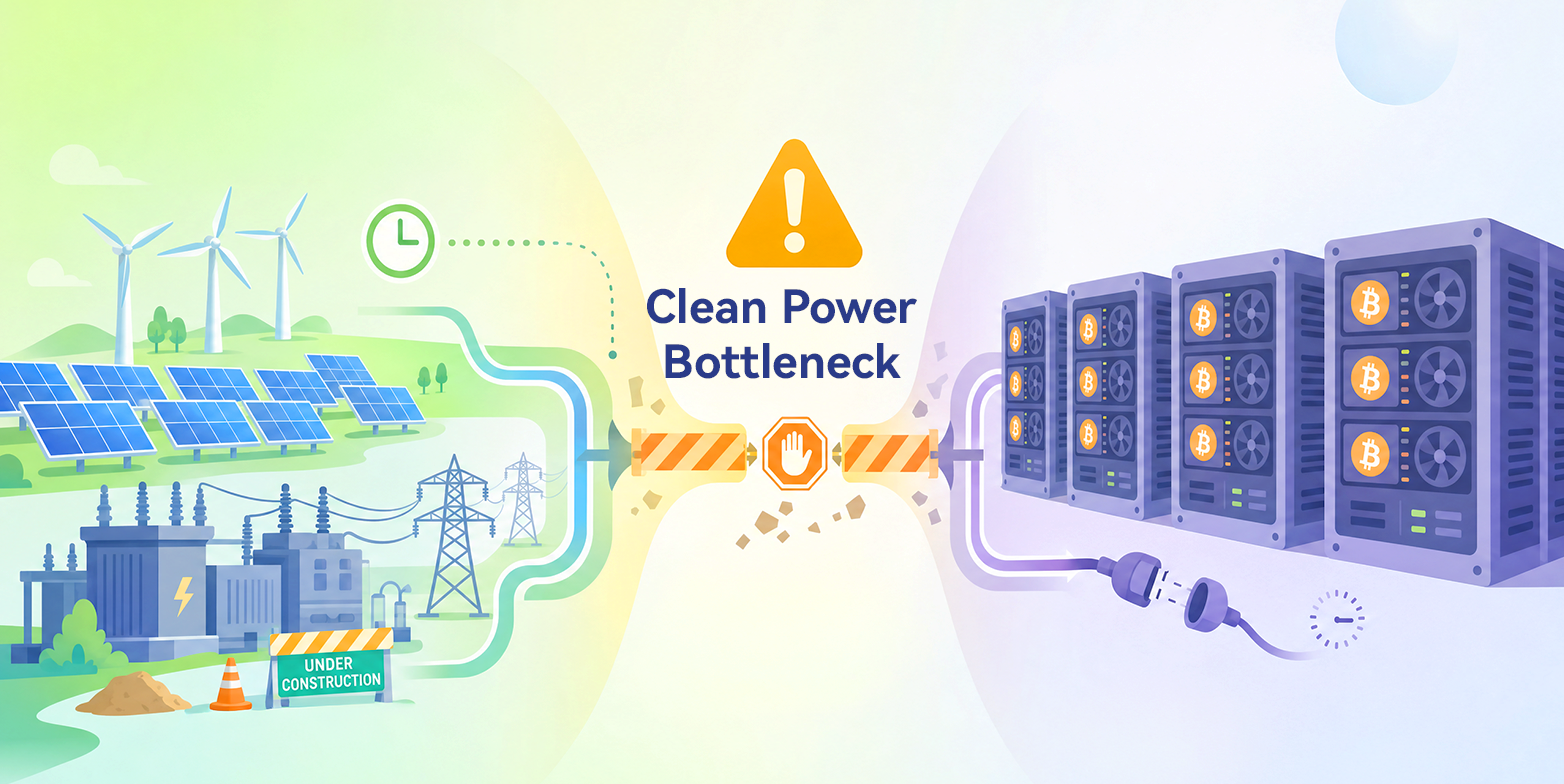
Clean Power Is Not Just a Low Electricity Price
In Bitcoin mining, clean power should be understood as a system, not a tariff. It includes the generation source, transmission path, interconnection status, seasonal output, curtailment rules, and whether the site can use that electricity when miners need it. Looking for broader context on renewable-energy mining data centers can explore the topic separately.
The clean-power transition is accelerating. The International Energy Agency projects that global renewable electricity capacity will increase by almost 4,600 GW between 2025 and 2030. That is encouraging, but more renewable capacity does not automatically become immediately usable power at a specific mining site. The practical question is not only “Is clean energy expanding?” It is “Can this location turn low-carbon electrons into stable, scheduled mining runtime?”
This distinction matters because an energy plan can look attractive on paper while remaining constrained in practice by queue delays, substation work, transformer lead times, local permitting, or a mismatch between variable generation and 24/7 computing demand.
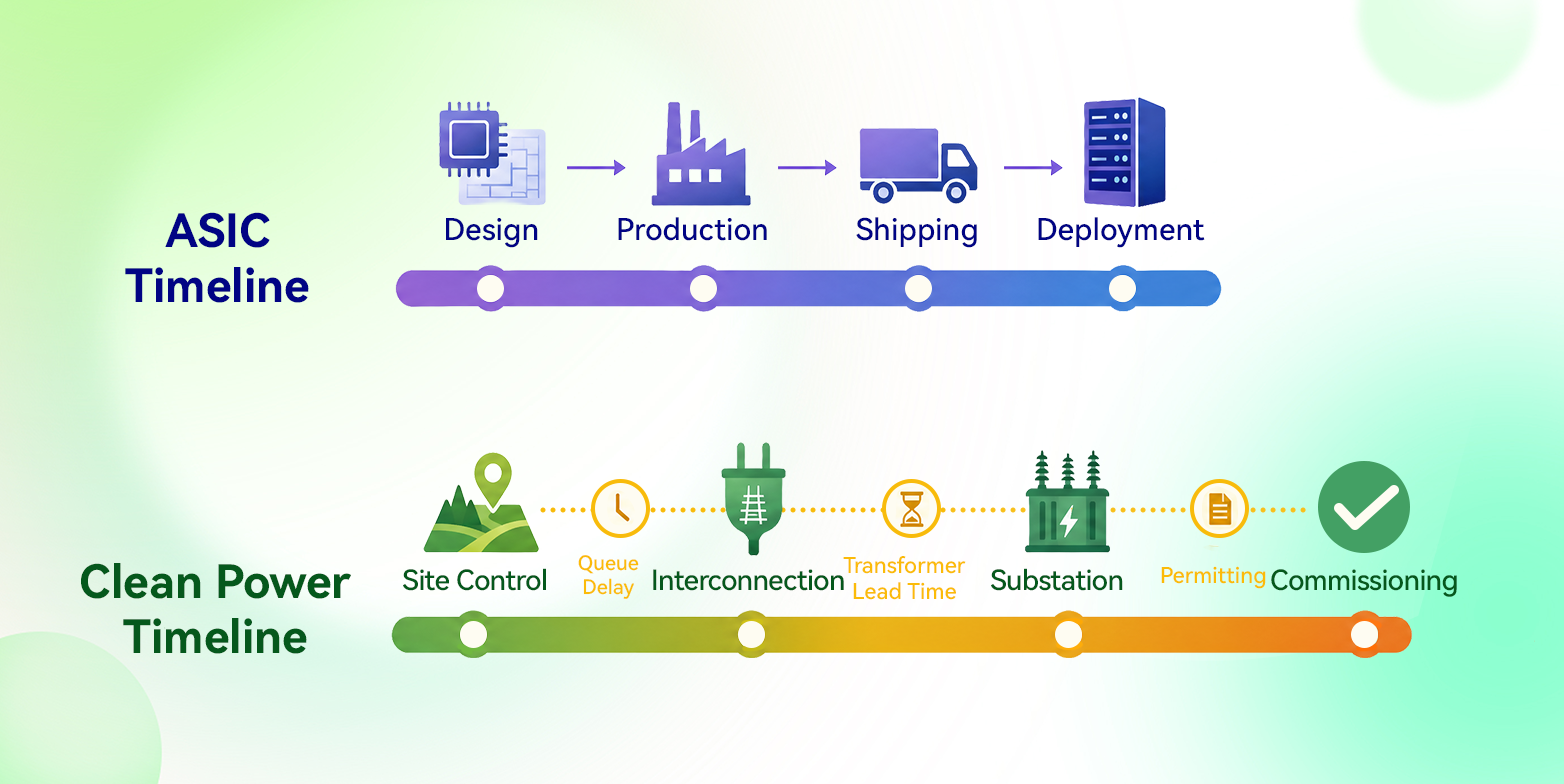
Why ASIC Timelines and Clean-Power Timelines Diverge
An ASIC miner is a manufactured product. Once the design is finalized, it can be produced, shipped, and deployed on a comparatively short cycle. Clean-power infrastructure is different. It may require site control, resource assessment, engineering studies, interconnection approval, transmission upgrades, substation construction, and commissioning before electrons are truly available to the mine.
That timing gap reshapes mining strategy in four ways:
- Power readiness: contracted or planned electricity is not the same as energized capacity.
- Schedule risk: hardware may arrive before the clean-power pathway is operational.
- Facility risk: a site may have partial power but still lack the electrical and thermal systems needed for full-scale deployment.
- Capital efficiency: a highly efficient miner that cannot be energized is still idle capital.
- This is why mining planning increasingly starts with infrastructure maturity rather than machine specifications alone.
Why Efficiency Matters for Clean-Power Mining
ASIC efficiency is often expressed in joules per terahash (J/T). In simple terms, it tells you how much electricity is required to produce a given amount of computational output. Lower J/T means lower direct electricity demand for the same amount of Bitcoin hash rate.
A product example makes that difference easier to read. The SEALMINER A4 Pro Air is listed at 10.9 J/T, while the SEALMINER A4 Ultra Hydro is listed at 9.45 J/T. On an equal-hashrate basis, that gap implies about 13% lower energy use per terahash, compared with a 10.9 J/T baseline.
For clean-power sites, that matters in practical terms.When usable electricity is limited, intermittent, or still coming online in phases, better efficiency can help turn the same available power into more productive computing work. It can also reduce heat generation, easing pressure on supporting power distribution and cooling systems. Operators can refine those assumptions by modeling electricity cost, machine efficiency, BTC price, and network difficulty together.
Efficiency therefore matters not only as a hardware specification, but also as part of a broader infrastructure strategy. It helps operators make better use of available clean power, improve deployment flexibility, and strengthen mining economics under the site’s actual operating conditions.
Clean Power Changes the Deployment Checklist
A mining site built around clean power needs a broader readiness test than “Is the electricity cheap?” The following questions are more useful:
Is the clean generation actually online, or only planned, contracted, or waiting in a queue?
Is the interconnection approved and the substation path sufficiently mature?
How variable is the energy source, and how will the site handle curtailment or low-output periods?
Are storage, firming power, or flexible operating schedules part of the model?
Can power distribution, cooling, maintenance, and monitoring systems operate under the expected load profile?
In some renewable-rich or remote settings, off-grid mining becomes part of the discussion. But off-grid does not mean “infrastructure-free.” It often raises the importance of storage, control systems, generation forecasting, and a disciplined plan for variable runtime.
Hardware Choice Should Follow Infrastructure Readiness
When clean-power buildout is still catching up, a diversified hardware strategy can provide more than one efficient deployment path. Bitdeer’s SEALMINER A4 series illustrates that principle without changing the broader point: equipment format should reflect infrastructure readiness. A lower-intervention air-cooling path can suit partially prepared sites, while a higher-density hydro-cooling path can make more sense where electrical, thermal, and operations systems are already mature.
The important lesson is not that any single machine solves the clean-power bottleneck. It is that hardware selection should reduce deployment friction rather than create a second bottleneck on top of an energy project that is already moving slowly.
Why Clean Power Is the Strategic Variable
Clean power matters because it can shape emissions intensity, long-run sourcing strategy, siting decisions, and public acceptance of new mining capacity. It also changes how operators think about mining energy consumption: not simply as a monthly bill, but as a system constraint that determines what can be deployed, where, and on what schedule.
Yet clean power creates value only when it is usable. A low-carbon project stuck in interconnection, or a solar-heavy site without a realistic operating plan, does not automatically improve mining economics. The strongest strategies connect three layers at once: efficient hardware, credible infrastructure timing, and a clean-energy plan that matches the site’s actual operating profile.
A More Practical Question for Miners
Instead of asking only, “Which machine is best?”, miners should ask:
What clean-energy source is available at this site, and how dependable is its delivery timeline?
Is the site expected to run continuously, seasonally, or with regular curtailment?
Does the hardware choice match the site’s electrical and thermal maturity?
Are profitability assumptions stress-tested against variable runtime, changing network conditions, and electricity-price sensitivity?
Will the deployment remain practical if clean-power infrastructure slips by several months?
Final Takeaway
Clean power is no longer a side note in Bitcoin mining. It is becoming one of the main constraints that determines whether efficient ASICs turn into productive hashrate on schedule. The more resilient strategy is to pair hardware efficiency with realistic infrastructure planning: verified energy timelines, grid readiness, flexible deployment paths, and assumptions that stay honest about variability. For more background on mining economics, energy use, and sustainable deployment models, you can continue through the Bitdeer Learning Hub.
*Information provided in this article is for general information and reference only and does not constitute nor is intended to be construed as any advertisement, professional advice, offer, solicitation, or recommendation to deal in any product. No guarantee, representation, warranty or undertaking, express or implied, is made as to the fairness, accuracy, timeliness, completeness or correctness of any information, or the future returns, performance or outcome of any product. Bitdeer expressly excludes any and all liability (to the extent permitted by applicable law) in respect of the information provided in this article, and in no event shall Bitdeer be liable to any person for any losses incurred or damages suffered as a result of any reliance on any information in this article.


