
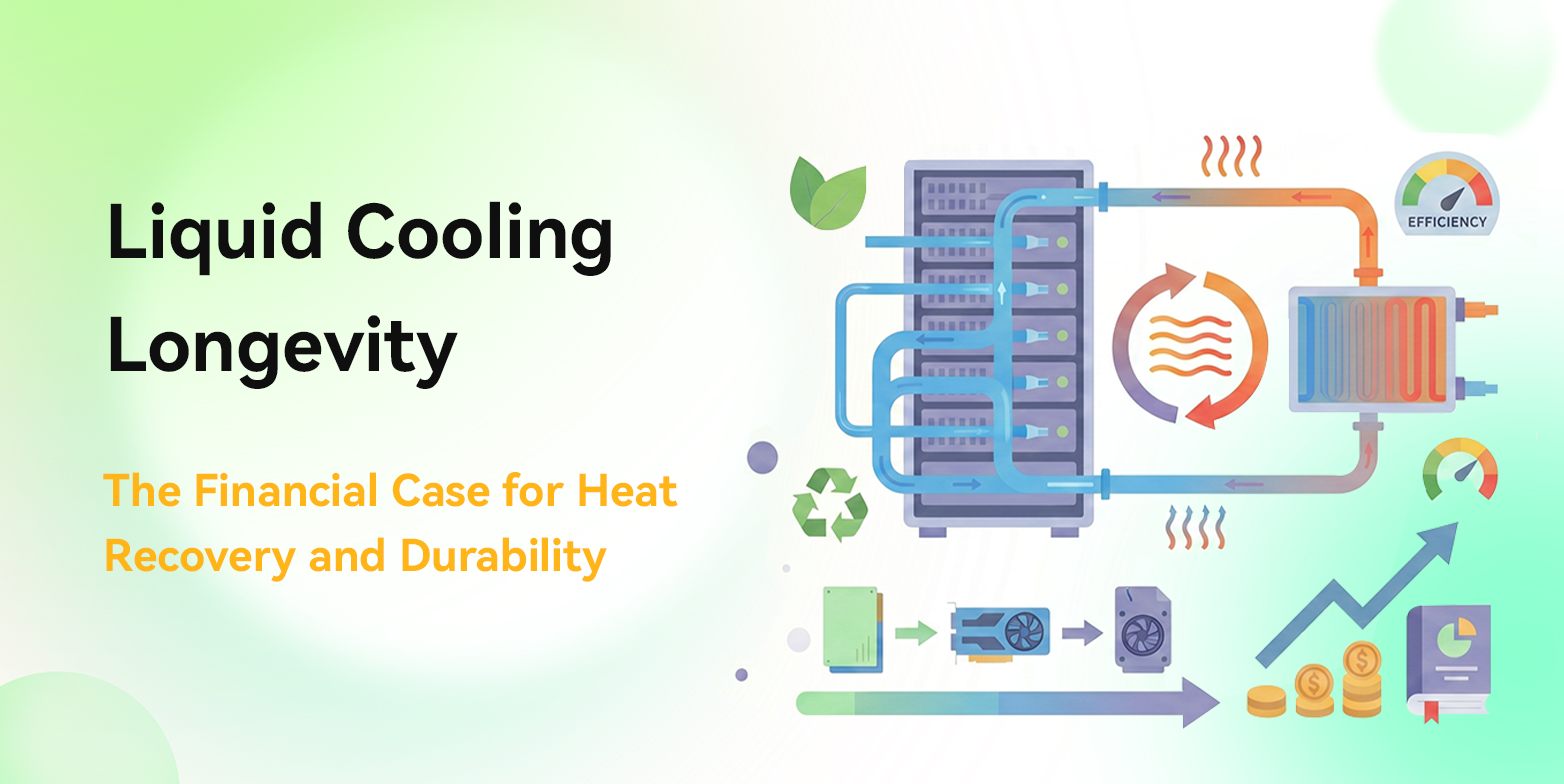
Liquid Cooling Longevity: The Financial Case for Heat Recovery and Durability
Apr 21st, 2026
This blog analyzes why liquid cooling is becoming a long-term financial calculation worth serious consideration for high-density mining farms from three perspectives: hardware durability, waste heat recovery, and long-term mining farm costs.
As AI data centers and high-power computing devices demand higher cooling capacities, liquid cooling is evolving from a "premium cooling solution" into a long-term investment at the infrastructure level. For Bitcoin mining farms, the value of liquid cooling should not be measured by "cooling effect" alone. It fundamentally impacts equipment failure rates, maintenance frequency, hardware lifespan, waste heat recovery capabilities, and the Total Cost of Ownership (TCO) over multi-year operational cycles. This article analyzes why liquid cooling is becoming a long-term financial calculation worth serious consideration for high-density mining farms from three perspectives: hardware durability, waste heat recovery, and long-term mining farm costs.
Why steady temps mean Pro Cooling
Intuition often suggests that cooling is simply about finding ways to make a machine "cold." However, in 2026, with chip power consumption frequently approaching the kilowatt level, the cooling philosophy has shifted: rather than pushing temperatures to an extreme low, maintaining them within a stable range over the long term is often more critical.
Compared to liquid cooling, traditional air-cooling systems are significantly more sensitive to ambient temperatures, intake air quality, and airflow organization. In high-temperature regions, air-cooled mining farms are more susceptible to seasonal climate impacts. When outdoor temperatures continue to rise, intake temperatures, airflow efficiency, and equipment thermal loads all come under pressure, increasing the probability of frequency downscaling, alerts, or shutdowns. This cooling method, which fluctuates with the weather, makes hashrate output highly unstable.
The advantage of liquid cooling is not complete isolation from the external environment, but rather its superior ability—compared to air-cooled systems that rely solely on intake temperatures—to keep chip operating temperatures within a relatively stable range. For high-power equipment, this thermal stability holds more long-term value than "dropping lower for a short time."
Schneider Electric, in discussions regarding liquid cooling for AI data centers, emphasizes that as rack power density continues to rise, direct-to-chip liquid cooling is becoming an essential path for handling high-heat-flux devices. This logic applies equally to mining farms: more stable thermal management ultimately impacts equipment availability and maintenance costs.
Why is thermal expansion the "invisible killer" of miner lifespan?
Actual cases of hardware damage show that chip issues often arise not because they are "constantly at a high temperature," but because "the temperature keeps changing."
Simply put, the interior of a miner is composed of different materials like silicon, copper, and solder. Their physical properties dictate that they expand to different degrees when heated. In an air-cooled environment where temperatures frequently fluctuate, these materials constantly "clash"—one expands slightly while another contracts. This micro-tugging accumulates stress within the solder joints.
From an electronic reliability perspective, frequent thermal cycling exacerbates stress accumulation in solder joints, packaging, and board-level interconnects. For ASIC devices running at full load over the long term, these temperature fluctuations increase post-maintenance pressure. It should be noted that specific failure rates still depend on equipment design, operating temperatures, cooling solutions, and maintenance levels.
This is where the long-term value of liquid cooling manifests. By providing a smoother heat exchange process, it helps reduce the additional stress caused by frequent temperature changes. For high-performance miners whose value per unit of hashrate continues to rise, a stable thermal environment is not merely an operations concern; it also plays a growing role in determining the equipment’s effective service life. In 2026, for machines such as the A4 Ultra Hydro, where each unit represents substantial hashrate value, using liquid cooling to maintain a stable operating temperature is, in essence, a way to slow the physical aging of expensive silicon.
From a secondary market perspective, equipment with a more stable long-term operating environment and complete temperature control logs generally earns more trust from buyers. If liquid cooling records can prove that a device was maintained under optimal thermal management conditions, it may help bolster its transaction appeal. It’s like buying a used car; people prefer one that has been driven on long highway stretches over one that has spent its life in stop-and-go city traffic.
Is waste heat recovery valuable? How does it work?
When liquid cooling is mentioned, many people think of "heating greenhouses" or "warming swimming pools." While this is physically feasible, it follows a very realistic screening logic in economic terms.
The advantage of liquid cooling is that liquids can concentrate heat. With appropriate system design, liquid cooling loops can output a more concentrated, higher-temperature usable heat flow; in some mining heat recovery cases, the cooling medium temperature can approach 70°C. In contrast, the heat exhausted by air cooling is like pepper scattered in the wind—large in volume, low in temperature, and dispersed—making engineered recovery much more difficult.
This higher-temperature, more concentrated heat flow is generally better suited for subsequent heat exchange or recovery systems than air-cooled exhaust. The value of heat recovery is not a matter of "can it be done," but "is there someone nearby who wants it." Heat loss during transmission is significant; if there are no greenhouses, factories, or residential areas within 5 kilometers of your mining farm, that heat can only be discharged into a cooling tower.
For mining farms located in high-latitude regions like Northern Europe or North America, heat recovery acts more like a "heating bill voucher." If you can sell waste heat to a local heating system, that income can directly offset a portion of your operational electricity costs. The conclusion is simple: heat recovery can lower your net electricity bill, but only if you choose the right location.
The long-term ledger of Liquid Cooling: maintenance, density, lifespan, and residual value
Constructing a liquid-cooled mining farm is indeed more expensive than an air-cooled one. Pump sets, heat exchangers, coolants, and complex piping significantly drive up your initial investment. So, why calculate this long-term ledger? It involves a trade-off between "initial cost" and "maintenance cost." If you plan to hold hardware for a long cycle in 2026, the advantages of liquid cooling "pay back" through these four dimensions:
Maintenance and Downtime
In the ledger of air-cooled mining farms, there is a "hidden rule" rarely calculated independently: the fans themselves consume electricity. For high-RPM air-cooled devices, this auxiliary energy consumption, while typically much lower than the main chip power, accumulates into a visible cost over long-term operation. More importantly, air-cooling fans are usually wearable parts, and dust and moisture constantly corrode the hashboards.
Compared to air-cooled solutions that rely on massive high-speed fans for heat dissipation, many liquid-cooled miners designed for high-density deployment can significantly reduce the fan burden on the device side, with some designs even eliminating chassis fans. Under the same power consumption, liquid cooling can convert this "fan power" into headroom for the chip or directly reduce the power distribution requirements for the entire unit. In an operational cycle of 3-5 years, the saved electricity costs often offset a portion of the liquid cooling infrastructure premium. However, it should be noted that technical routes differ: cold-plate solutions and immersion cooling vary in sealing methods, maintenance logic, and environmental isolation.
Spatial Density
2U and 3U liquid-cooled miners provide a better physical foundation for high-density deployment, but whether more hashrate can ultimately be deployed in the same room area depends on power distribution, piping organization, rack design, and maintenance channel planning. For regions with high land lease costs, this represents a form of hidden financial dilution. Learn more about 2U vs. 3U: Miner Weight, Design, and Profit Logic.
Equipment Lifespan
Intuition tells us that "heat breaks machines," but how do we estimate this? In electronic reliability engineering, increased temperatures typically accelerate certain failure mechanisms; therefore, the higher the long-term operating temperature, the greater the pressure on equipment reliability. The industry often uses the "10°C rule" as a rough estimate, though it doesn’t apply to all failure modes. The "10°C rule" suggests that within a certain temperature range, for every 10°C decrease in a chip's operating temperature, its failure rate is approximately halved.
In a simplified projection, lower operating temperatures and smaller temperature fluctuations generally help slow down some temperature-sensitive failure mechanisms. However, this doesn't mean you can mechanically translate a "20°C drop" into a fixed percentage of lifespan increase. For a mining farm, the more realistic judgment is that liquid cooling offers the opportunity to improve long-term thermal management, reduce reliability pressure, and extend the window of time that equipment maintains a good online rate.
Heat Recovery and Residual Value
In the secondary hashrate market of 2026, an interesting phenomenon has emerged: the "environmental log" of liquid-cooled machines has become the strongest credit endorsement. The secret is that the fatal flaw for air-cooled machines isn't just heat, but the chemical reaction of "dust + humidity + temperature variance." Air-cooling fans suck in thousands of cubic meters of air per hour, and the sulfides and moisture within leave irreversible micro-corrosion on the PCB.
From an asset management perspective, the more stable the long-term operating environment and the clearer the maintenance records, the easier it is for equipment to earn buyer trust during resale. If liquid-cooled equipment can provide complete operational and temperature control logs, it theoretically helps improve its residual value performance. However, whether this premium exists consistently depends on the specific model and market cycle.
How to calculate Liquid Cooling ROI?
We can establish a simple "Liquid Cooling TCO Hedge Model" to help you decide:
TCO(Advantage) = (E_fan savings+ E_output gain) - (C_initial premium- R_residual increase)
E_fan savings: (Single-unit fan power × 24h × 365 days × Electricity price)
E_output gain: Potential revenue loss due to frequency downscaling or downtime in an air-cooled environment, versus the output improvement brought by the liquid cooling system, reducing such risks.
R_residual increase: The potential resale difference liquid-cooled equipment might show across different market cycles, estimated based on actual transaction data.
If you want to truly incorporate liquid cooling value into investment projections, a TCO perspective is more appropriate than just comparing equipment purchase prices. A more complete model should consider at least initial liquid cooling conversion costs, changes in auxiliary energy consumption, downtime losses, maintenance and spare parts expenditures, changes in equipment lifespan, and residual value differences. In scenarios with high electricity prices, long holding cycles, and high downtime costs, the financial advantages of liquid cooling are typically more apparent.
Asset management over machine hoarding
In 2026, with low margins and intense competition, the logic of mining farm operations has changed. In the past, people competed over who could buy the newest machines; now, they compete over who can make those machines run longer and more stably. Liquid cooling technology essentially uses precise engineering to combat physical attrition.
When the criterion for judgment shifts from "how much more can I make this month" to "what is the total cost over five years," the value of liquid cooling no longer lies just in cooling efficiency, but in whether the equipment can generate revenue more stably and for a longer duration. Recommend that you visit the Bitdeer Advanced mining calculator to input specific operational parameters and verify your mining farm's payback period and long-term ROI performance from a quantitative dimension.
*Information provided in this article is for general information and reference only and does not constitute nor is intended to be construed as any advertisement, professional advice, offer, solicitation, or recommendation to deal in any product. No guarantee, representation, warranty or undertaking, express or implied, is made as to the fairness, accuracy, timeliness, completeness or correctness of any information, or the future returns, performance or outcome of any product. Bitdeer expressly excludes any and all liability (to the extent permitted by applicable law) in respect of the information provided in this article, and in no event shall Bitdeer be liable to any person for any losses incurred or damages suffered as a result of any reliance on any information in this article.


