
How Should Large Mining Facilities Choose Industrial Bitcoin Miners in 2026
10.06.2026
Guide to selecting industrial Bitcoin miners, comparing air & water cooling, analyzing efficiency, hashrate and ROI for large mining operations.
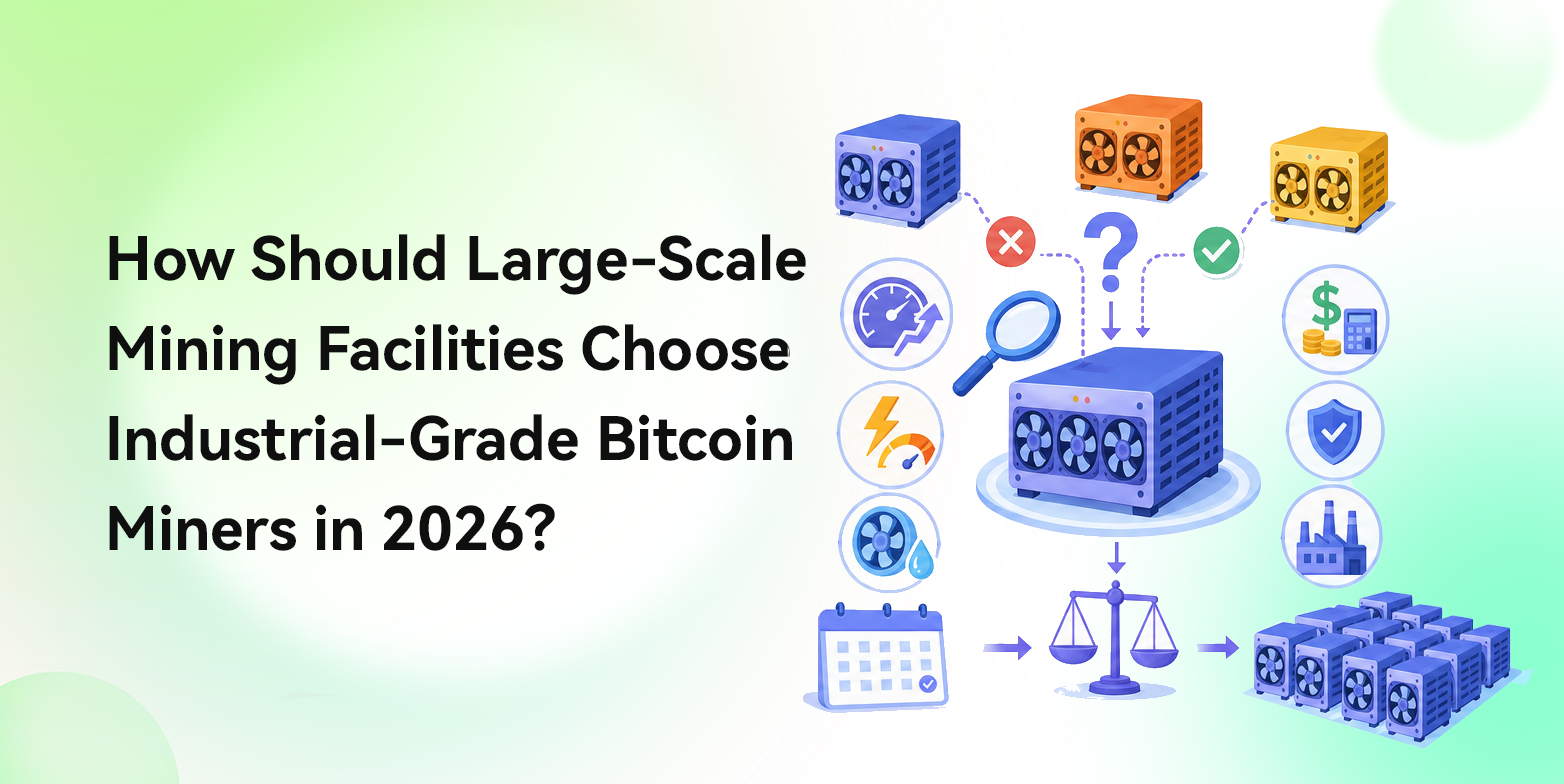
In 2026, Bitcoin mining can no longer be decided by the simple logic of “buying the highest-hashrate hardware.” After Bitcoin’s fourth halving in 2024, the block subsidy dropped to 3.125 BTC. At the same time, network difficulty adjusts periodically with changes in total network hashrate, and mining facility revenue is affected by BTC price, difficulty, transaction fees, electricity price, and equipment efficiency. For large-scale mining facilities, selecting Bitcoin mining hardware is not just a procurement issue. It is closer to a long-term energy business.
This article looks at what defines industrial-grade Bitcoin mining hardware, key operating parameters, the differences between air-cooling and hydro-cooling designs, ROI evaluation, and site fit. It helps you decide what type of ASIC miner is more suitable for large-scale deployment, which metrics actually affect profitability, and which risks cannot be covered by optimistic revenue estimates alone.
What Is an Industrial-Grade Bitcoin Miner?
What Is the Difference Between Industrial-Grade Miners and Ordinary Miners?
Industrial-grade Bitcoin miners are usually ASIC miners designed for long-term continuous operation, batch deployment, and professional mining operations. The key is not simply delivering higher hashrate, but whether the hardware can maintain stable hashrate under heavy load and convert each kilowatt-hour into effective computing power.
Think of a miner as a production line operating within a factory. Hashrate is production capacity, power consumption is energy use, and J/TH is the electricity efficiency of each unit of capacity. A small gap in one unit may not look obvious. But when there are hundreds or thousands of ASIC miners, the efficiency gap becomes a long-term electricity cost gap. For large-scale mining facilities, the value of an industrial-grade miner is not only single-unit performance. It is whether the equipment still supports unified power supply, unified cooling, unified monitoring, unified maintenance, and predictable downtime, repair response, and maintenance cost after the fleet expands to hundreds or thousands of units.
Why Do Large-Scale Mining Facilities Pay More Attention to Industrial-Grade Miners?
The profit of a large-scale mining facility often does not depend on one ASIC miner. It depends on whether the whole fleet can run with low downtime, low energy use, and manageable maintenance. Miner downtime means lost revenue for that day. Unstable cooling increases repair needs and shortens hardware lifespan. Higher energy consumption pushes the farm closer to its shutdown threshold when BTC price falls or difficulty rises.
So, the core of selecting industrial-grade mining hardware is not “the highest hashrate.” It is “which equipment can provide more stable long-term cash flow under your electricity price and site conditions.”
What Should You Consider Before Choosing Bitcoin Miners?
Hashrate and Hashprice
Hashrate is the computing power a miner contributes to network competition, but it does not represent revenue on its own. The Bitcoin network does not assign fixed production or revenue to any single miner. Revenue also depends on total network hashrate, mining difficulty, block rewards, and transaction fees.
A more useful metric to review separately is hashprice. Hashrate tells you how much computing power a miner has, while hashprice shows roughly how much revenue one unit of hashrate can generate on a given day. When large-scale mining facilities evaluate daily cash flow, hashprice is closer to real operating conditions than simply watching BTC price. If hashprice declines, the payback period will be stretched even if the miner’s hashrate stays the same.
Energy Efficiency and Electricity Cost
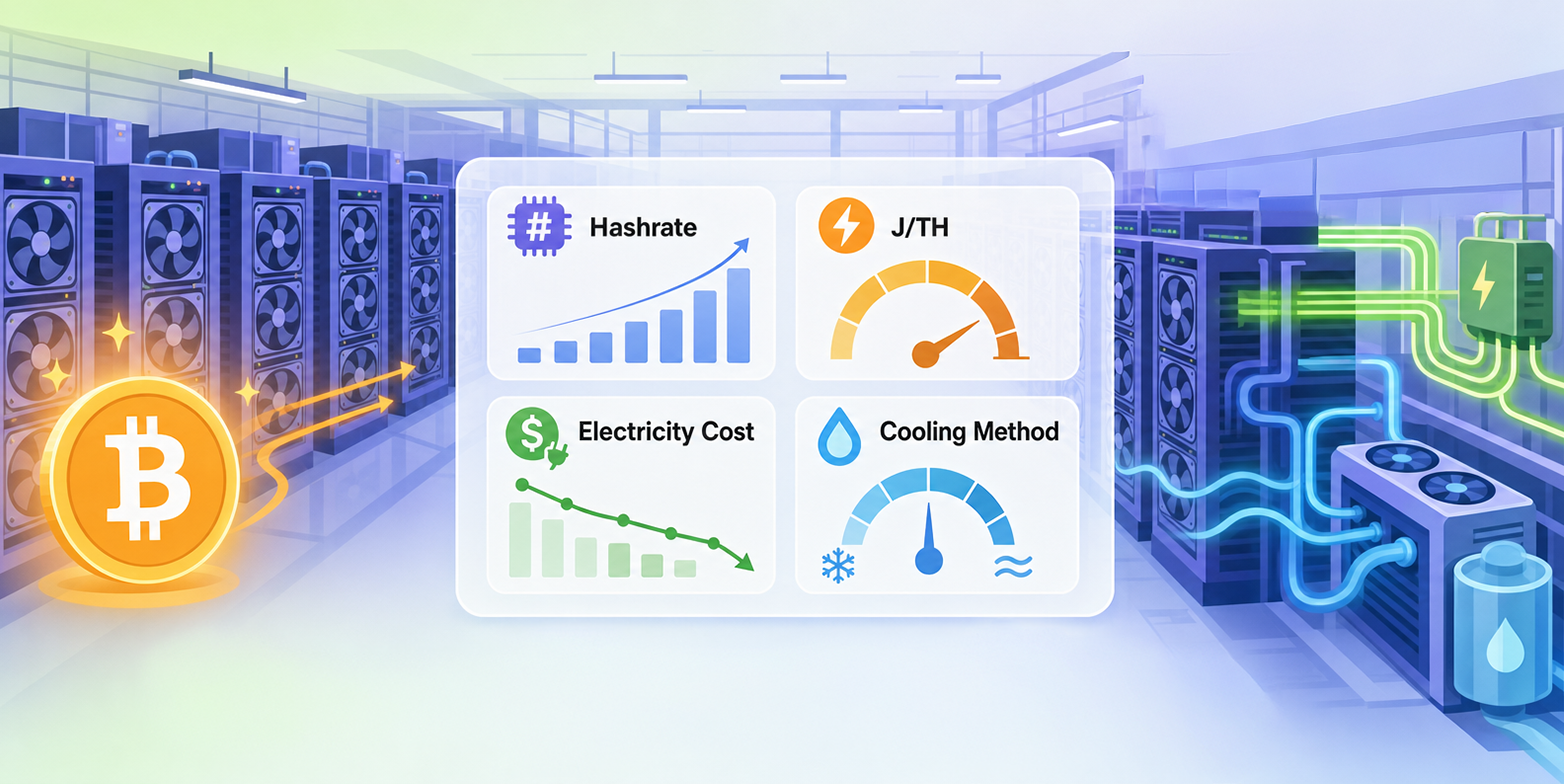
One of the most important indicators for a large-scale mining facility is J/TH. The lower this number is, the less electricity is used for the same hashrate. Different models should not be ranked only by “higher or lower hashrate.” Hashrate, power consumption, energy efficiency, and cooling method should be reviewed in the same table.
| Model | Type | Hashrate | PE | Better Suited Scenario |
| SEALMINER A4 Pro Air | Air cooling | 336 TH/s | 3.66 kW; 10.9 J/TH | Air-cooling or phased expansion |
| SEALMINER A4 Pro Hydro | Hydro cooling | 680 TH/s | 7.41 kW; 10.9 J/TH | Hydro systems; denser cabinets |
| SEALMINER A4 Ultra Hydro | Hydro cooling | 886 TH/s | 8.37 kW; 9.45 J/TH | High-density, low-cost-per-TH sites |
A simple electricity cost calculation can be viewed this way:
| Equipment Power | Daily Electricity Use | Electricity Price: $0.06/kWh | Electricity Price: $0.10/kWh |
| 3.66 kW | About 87.8 kWh | About $5.27/day | About $8.78/day |
| 7.41 kW | About 177.9 kWh | About $10.67/day | About $17.79/day |
| 8.37 kW | About 200.9 kWh | About $12.05/day | About $20.09/day |
These figures represent static cost baseline stress tests, not dynamic yield projections. When the revenue side is uncertain, the more controllable the cost side is, the stronger the mining facility’s resilience will be.
Purchase Cost, Hardware Lifespan, and Maintenance Expenses
The miner purchase price is only the first layer of cost. Large-scale mining facilities also need to consider power distribution, cooling, racks, network, spare parts, repair response time, site rent, and downtime loss. A cheap miner is not necessarily cheap if its efficiency is poor or its failure rate is high. A high-performance miner also may not reach its rated hashrate if the infrastructure cannot support it.
When judging a miner, you can first look at these dimensions:
| Metric | Decision Meaning |
| Hashrate | Determines the ability to compete in mining |
| J/TH | Defines long-term electricity cost pressure |
| Power use | Affects power capacity and site planning |
| Cooling method | Affects deployment density, noise, and maintenance difficulty |
| O&M support | Affects repair response, downtime, and long-term stability |
Air-cooling vs. Hydro-cooling Bitcoin Miners: Which Is Better?
Air-cooling Miners Are Suitable for Flexible Deployment
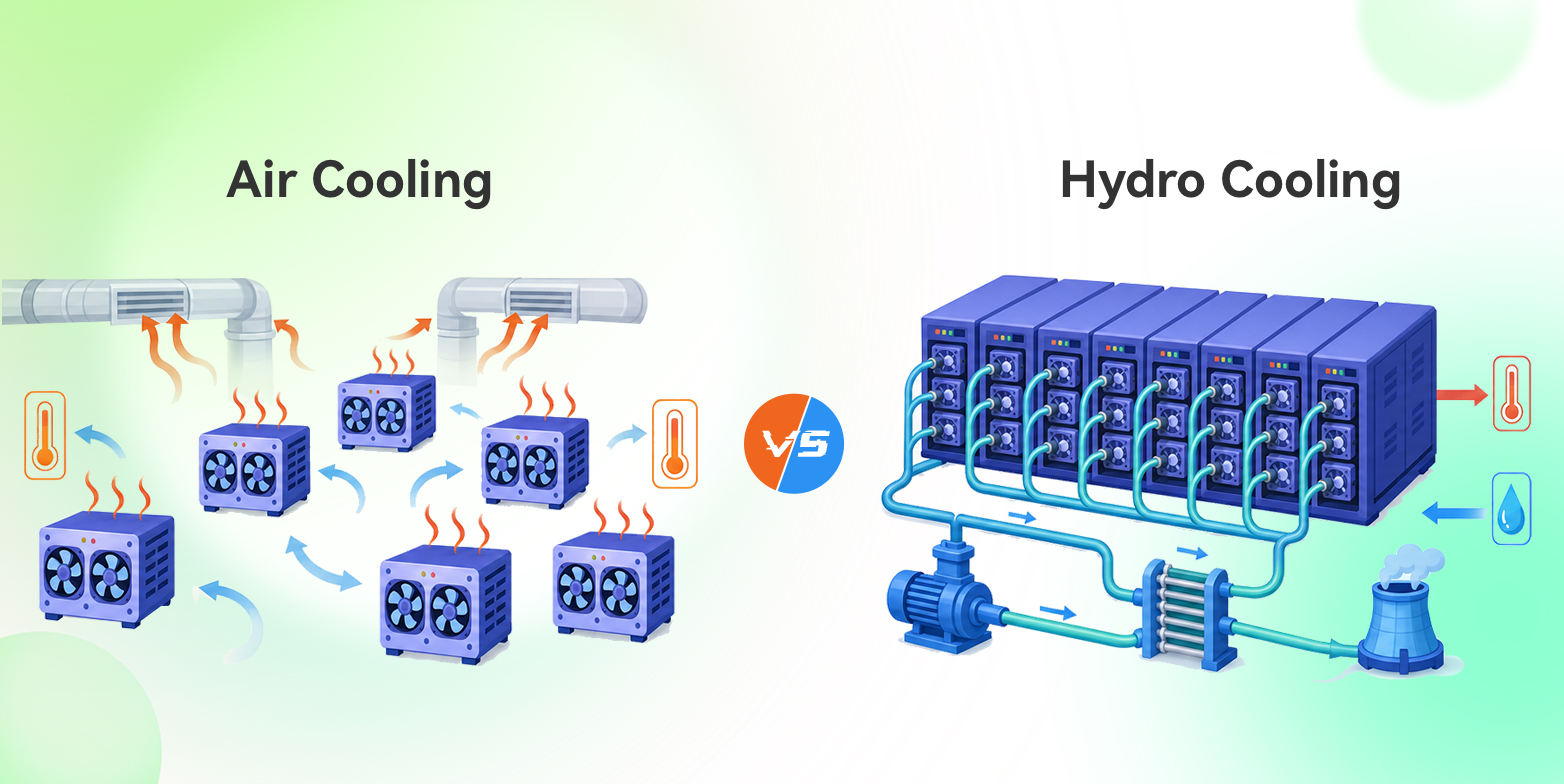
Air-cooling miners have a relatively low deployment threshold. They are more suitable for small and mid-sized mining facilities, upgrades of existing sites, or users who want to control infrastructure investment first. Their advantage is that installation and maintenance are more straightforward, and capacity expansion is also more flexible.
However, air cooling is more sensitive to ventilation, temperature, dust, and noise. If the mining facility is located in a high-temperature region or the site has average ventilation conditions, cooling pressure will become a long-term O&M cost. Air cooling can still be used in large-scale mining operations, but the environment and exhaust capacity must be confirmed first.
Hydro-cooling Miners Are Suitable for High-Density Long-Term Operations
Hydro-cooling miners are more suitable for large-scale mining facilities that need high density, rack-based deployment, and long-term operation. Taking the SEALMINER A4 series as an example, A4 Ultra Hydro and A4 Pro Hydro use a hydro-cooling design, making them more suitable for mining facilities with requirements for hashrate density, cooling stability, and noise control.
The logic of hydro cooling is not that it is “more advanced.” It upgrades heat management from single-machine fans to a centralized cooling system. In the early stage, it has higher requirements for water loops, heat exchange, water quality, pumps, pipe sealing, and O&M procedures. But in high-density deployment, it can help a mining facility manage heat, space, and downtime risk more effectively. The downsides of hydro cooling also need to be calculated in advance.
First, the farm needs to reserve space for cooling towers, heat exchangers, water pumps, filtration, and leak monitoring. Second, if water quality management is not done properly, scaling, corrosion, or blockage in the pipes can affect heat dissipation. Third, if pumps, electrical controls, or pipelines fail, the impact may not be limited to one miner. It may affect a whole row of cabinets. In high-humidity regions, freezing conditions, water-scarce areas, or projects without field experience in hydro-cooling O&M, backup pumps, spare parts, inspection frequency, and downtime plans must all be included in the cost.
Therefore, hydro cooling does not automatically bring higher profitability. If the mining facility is not large enough, the O&M team lacks experience with water-loop infrastructure, or local electricity and space costs do not support high-density deployment, the upfront investment and system complexity of hydro cooling may instead extend the payback period.
| Solution | Better Suited mining facility | Main Advantage | Main Limit |
| Air cooling | Flexible expansion; small or mid-sized sites | Fast deployment; simple infrastructure | Noise, exhaust airflow, and temperature pressure |
| Hydro cooling | Large-scale, high-density rack deployment | Stable cooling; high density; low noise | Higher system design and O&M requirements |
How Can You Estimate Mining Profitability and ROI?
What Is the Revenue Structure of a mining facility?
Bitcoin mining facility revenue mainly comes from block subsidies and transaction fees, but the final payout is not determined by a single ASIC miner. The revenue side is affected by total network difficulty, block rewards, transaction fees, mining pool settlement rules, effective equipment hashrate, and uptime. The cost side includes hardware purchase costs, electricity, cooling, power infrastructure, site, maintenance, spare parts, and labor costs. When large-scale mining facilities calculate ROI, they cannot treat “daily coin output” alone as revenue. Actual uptime and pool fees also need to be deducted.
The basic formula can be simplified as:
Mining profit = mining revenue - electricity cost - operating cost
This formula cannot directly provide a certain ROI, but it helps you avoid a common mistake: looking only at daily coin output while ignoring electricity and downtime costs. When the formula is broken down, the revenue side is closer to “hashprice × effective hashrate × online time,” while the cost side is divided into fixed costs and variable costs. Fixed costs include mining hardware, racks, power distribution, and site investment. Variable costs mainly include electricity, cooling, repair, and mining-pool-related fees.
For large-scale mining facilities, ROI calculation is not only about “how long it takes to break even.” The more important question is under what conditions the equipment will approach the shutdown threshold. When BTC price falls, difficulty rises, hashprice declines, or electricity price increases, low-efficiency equipment loses its economic value faster. Therefore, the procurement stage should include reverse calculations: under different hashprice levels, how high an electricity price can the equipment still tolerate? Under the expected uptime or downtime level, can cash flow still cover fixed costs? If a miner is only profitable under extremely low electricity prices and extremely high uptime, it should be treated as a high-risk option.
How Should Beginners Judge ROI?
For beginners, it is not recommended to start with a complex model, and it is also not recommended to look only at one optimistic payback number. A more practical method is to list the equipment purchase price, shipping cost, tariffs or other delivery costs, electricity cost, pool fees, site cost, and maintenance cost first. Then use “daily net income = daily mining revenue - daily electricity cost - daily operating cost” to work backward to the payback period. The key is not to calculate a good-looking number, but to know which variables can turn a project from profitable to loss-making.
In a preliminary estimate, you can first use a clear mining profitability calculation method to break down daily output, electricity cost, daily net income, payback days, and return on investment. For a large-scale mining facility project, this method should also include three stress tests: whether cash flow can still cover electricity cost when hashprice declines, whether cash flow can withstand lower equipment uptime, and whether the project remains above the shutdown threshold after electricity price increases. Only when both neutral and conservative scenarios still make sense does ROI have real reference value.
Which Scenario Best Fits Your Mining Needs?
Low-Electricity-Price Regions
Regions with low electricity prices have a higher safety margin. They can place more emphasis on total hashrate, equipment stability, and batch deployment efficiency. But low electricity price does not mean energy efficiency can be ignored. As difficulty rises, inefficient equipment can still be phased out.
If you are planning expansion, you need to focus on electricity contracts, hardware upgrades, financial cycles, and compliance boundaries rather than simply increasing the number of ASIC miners.
High-Electricity-Price or Power-Limited Regions
High-electricity-price regions should prioritize low-J/TH equipment. With the same 1 MW power capacity, efficient miners can convert more electricity into effective hashrate. In this situation, energy efficiency is not a marketing parameter. It is the break-even operating threshold that determines whether the mining facility can keep running.
If the site location has not been decided, you can first read Choosing the Right Location for Crypto Mining Containers to judge whether a mining facility is suitable for long-term operation from the perspectives of energy cost, climate, policy, and infrastructure.
How Do You Choose the Right Industrial-Grade Bitcoin Miner?
When a large-scale mining facility chooses industrial-grade Bitcoin miners, it should not start with “which one is the most expensive” or “which one has the highest hashrate.” It should start with its own electricity price, site conditions, cooling design, budget, and risk tolerance.
You can use five principles for the final judgment:
1. Look at J/TH first, then total hashrate.
2. Calculate electricity cost tolerance first, then estimate daily revenue.
3. Air cooling is suitable for flexible deployment, while hydro cooling is suitable for high-density long-term operations.
4. ROI should account for the break-even BTC price, difficulty, transaction fees, downtime, and maintenance.
5. Large-scale mining facilities should pay more attention to system stability, not only individual miner specifications.
If you are still in the early research stage, you can first use the Bitdeer Learning Hub to learn about hashrate, hashprice, mining facility site selection, and mining operations logic. If you are already evaluating equipment, you can combine Bitdeer miner parameters and Bitdeer Mining Insights to compare equipment efficiency, electricity cost, hashprice, and site conditions in the same table. The miner that truly fits a large-scale mining facility is not necessarily the one with the most eye-catching parameters. It is the one that can deliver consistent long-term hashrate output under your real cost structure.
*Information provided in this article is for general information and reference only and does not constitute nor is intended to be construed as any advertisement, professional advice, offer, solicitation, or recommendation to deal in any product. No guarantee, representation, warranty or undertaking, express or implied, is made as to the fairness, accuracy, timeliness, completeness or correctness of any information, or the future returns, performance or outcome of any product. Bitdeer expressly excludes any and all liability (to the extent permitted by applicable law) in respect of the information provided in this article, and in no event shall Bitdeer be liable to any person for any losses incurred or damages suffered as a result of any reliance on any information in this article.


